Saturday, May 18, 2013

The Crossing Point: Behaviors that shows how critical corridors are to elephants

A magnificent tusker crossing the road at the Crossing Point
To be up on a tree hut in the jungle is an exhilarating experience.  It was undoubtedly also about making connections with one’s childhood—bringing to life childhood fantasies as a result of reading Swiss Family Robinson, Tarzan of the Apes, and Robinson Crusoe.  Incidentally, Daniel Defoe based Robinson Crusoe on Englishman, Robert Knox’s experiences of 20 years forced incarceration in Sri Lanka by the last King of Kandy, Sri Vikrama Rajasinha.   

Group of volunteers in t he Tree Hut - a la Swiss Family Robinson
I assure we were not making an enactment of “Me Tarzan You Jane” since for me to play Tarzan at this age was a sure way to end up becoming a paraplegic.  Seriously, aside from the childhood fantasies—the actual reason why we were up on a tree hut in the Wasgamuwa jungles was to observe and study elephants.  

Observing wild elephants from a Tree Hut can turn out to be a fascinating activity.  Not too many things in life come close to that experience.  To have an entire elephant herd feeding underneath while the tree hut swayed to a gentle breeze with background music by various avian and forest fauna is a life changing experience.  There is a real danger of getting addicted to it.  

Studying a herd of elephants from the Tree Hut
For a while we had been noticing that the tree hut corridor was an unusual place mainly because both elephants and people used it frequently throughout the year.  The more we visited the corridor the more we realized that we knew very little about what went on when both elephants and people were in the same place.  Of course we had more than enough information from second and third hand accounts.  But we had very little primary information from first hand observations.  Over time the idea that we should build tree hut observation posts in the corridor got mooted as an activity to study the interactions of people and elephants.  This was back in 2003 when we had just completed erecting our second solar powered electric fence around the Weheragalagama village. 


Volunteers observing and taking down data from the Tree Hut
Several tree huts were built at the beginning.  One we built across the Weheragalagama Tank (reservoir) and found out that during the rainy season we could only access it by boat.  Over the years the tree hut at the Tree Hut Corridor became our primary observation hut due to it been located along the route that elephants moved between the Wasgamuwa National Park and the Himibiliyakade Forest Reserve.  The people who mostly traveled through the corridor belonged to two villages that were located in the forest reserve adjacent to the buffer zone of the national park.  The elephants of course ranged all over this region and were part of the large population of elephants that inhabited the area known as the lower Mahweli River Basin.

The Tree Hut
Until we started to conduct these observations in 2003 we had very little understanding of the interactions of people and elephants.  The observations from the tree hut definitely opened up an entirely different window that allowed us to get a good understanding of how elephants behaved when people were around.  Fortunately the corridor was used both by bulls and large herds consisting mostly females and young.   As time went by we gradually began to notice the nuances and the different patterns of behaviors of bulls and cows in response to various anthropogenic disturbances.

We’ve made some remarkably interesting observations of elephants as well as people over the years from the tree hut.  Cows and young, solitary bulls and/or groups of bulls—I meant elephants not people—reacted to disturbances along the Tree Hut Corridor very differently.  

Observing a herd of elephants from the ground as they are crossing the road at the Crossing Point
Female herds with young when they were just about to emerge from the forest always rushed back when they heard a human noise.  We had also noticed that female herds retreated only when they were just about to emerge from the forest, but once the disturbance had moved away they soon returned unless they had been really frightened off.  It was ironical in a way how these massive animals were so frightened of us puny humans.  Another interesting behavior was, once an entire herd was out in the open grassy woodland area any number of tuk tuks or other vehicles and people could come along the road and they will not move back to the forest.  They would just stop whatever they had been doing, bunched together and remained completely motionless and silent behind tall grass or scrub until the disturbance had moved away.  We have observed tuk uks, cyclists and motorcyclists driving past herds of elephants that were crowded together and hiding behind tall scrub and Mana grass just a few feet away from the edge of the road.  The drivers and passengers in these vehicles just drove past quite oblivious that a herd of wild elephants were just a few feet away!  On some occasions a herd would rush back to a safe distance and wait quietly until the disturbance had moved off. 

Bulls reacted somewhat differently. While the occasional bull would charge or attempt to chase people and vehicles, this did not happen frequently.  Most bulls tend to be laid back continuing to feed completely ignoring the people and vehicles.  Others would stand erect with heads raised and ears spread looking towards the direction where the disturbance was coming from or would slowly amble away into the jungle.  If they were taken unawares then they would trumpet piercingly turn tail and run.  Some would stop after a short distance and stare while others kept going until they disappeared into the forest.  It seems elephants were startled and frightened by the sudden appearance of people the same way people frightened each other. 


A bull charging - most times these are mock charges...but whose waiting to find out!
On one occasion three bulls were feeding right across from the tree hut about 50 yards away when a land-master two wheel tractor with a trailer loaded with men, women and children came chugging down the road.  These were farmers after working in the fields heading back to their village before night fall. The three bulls though did not pay any attention and nonchalantly kept feeding seemingly oblivious to the tractor and it occupants.  

The tractor driver though stopped immediately when he saw us signaling that there were elephants across the road.  The driver and the passengers stood up and peered to catch a glimpse of the elephants, but due to the tall Mana grass and the short height of the tractor they could not possibly see them well.  From the tree hut we gestured to the driver to keep driving.  He drove up to where we were and then refused to go any further saying that without been able to see the elephants he was not going to take the chance.  Normally we would have escorted the tractor with our field vehicle.  But that day the vehicle had dropped us off at the Tree Hut and gone on an errand.   With dusk falling fast it was important for the tractor to keep going while there was enough light to see the elephants. 

The Land Master Tractor with agitated villagers
While we were trying to convince the driver to continue on another tractor appeared at the other end.  That driver stopped immediately when he saw us guessing rightly that there must be elephants around.  In the meantime the women were imploring us to help them to get to the other end of the road so they could get home safely.  Deciding fast, a villager who happened to be with us and I climbed on to the tractor and went with them hoping to get a ride back from the other tractor.  Standing on the iron railings of the trailer we kept an eye on the elephants.   When we got to the other side to our consternation the driver of the second tractor refused to bring us back.  Abandoning wherever he was going and with total disregard to our situation he turned around and followed the tractor we had traveled back to the village.  Not expecting to be in such a dilemma, the two of us stood on the middle of the road and stared at the receding vehicles like two castaways watching a ship disappear over the horizon.  I wondered what it would do to his Karma if we were trampled by an elephant.  Not that that our Karma was in good shape either, considering we had to now hoof it down the road passing by three bull elephants. 

For a moment the villager and I, eyed each other wondering who will be the first to get pulverized by an elephant.  Shaking these macabre thoughts of our minds we convinced each other that the elephants looked calm enough and likely won’t bother us.  Imbued by this false sense of elephant human brotherhood and having no other choice we walked back towards the Tree Hut. While they had completely ignored the tractor now all three bulls had stopped feeding and were looking in our direction with raised heads, alertly watching as we walked down the road.  This was another anomalous behavior, while most times bulls were not bothered by vehicles or people on some occasions they were very alert to and vary of people moving on foot.  I wondered whether this had to do with the distance that separated the people and elephants at any time.   

Keeping a weary eye on the elephants we walked to the Tree Hut
Mentally I calculated what our chances were of reaching the Tree Hut if one or all of them decided to get to know us personally.  Our chances looked pretty dismal.  The road stretched straight like a buff colored ribbon through Mana grass with no place to take refuge in case of an attack.  The few trees that were there had trunks as straight as poplars seemingly to discourage people from climbing them.   With the three bulls staring—the two of us walked down the road like two self-conscious village damsels.  Acting nonchalant we walked down at an even pace keeping a vary eye on the elephants.  The planets must have been in proper alignment in our astrological charts and our Karma must have been better than anticipated because we made it back to the Tree Hut without incident.  What is closer to truth is contrary to currently held beliefs elephants are not eager to step on people every opportunity they get.

The road stretched along with no place to hide

Bulls tend to ignore people most of the time
How people reacted and behaved in the presence of elephants was also part of our study but in all honesty observing human behavior was more entertainment than science!  I must profess that when people and elephants were present in the corridor, the elephants behaved in a far more dignified manner than people.  Village men inebriated to the high heavens were the worst.  Imbued by a false sense of bravado from the liquor these drunks’ attitude was to tangle with the elephants.  At least David when he challenged Goliath had a sling shot! These idiots had only alcohol fumes.  On many occasions we had transported such intoxicated villagers to their homes fearing for their lives.  No wonder then, that of the 80 odd people that are killed annually by elephants the majority are drunks.  


A motorcyclist riding by a herd hiding motionless behind scrub

A belligerent drunk attempting to challenge the elephants!
Another rowdy behavior we have been observing lately was several pimped up tuk tuks that had taken to escorting convoys of small Land Master tractors.  

The ubiquitous and obnoxious Tuk Tuks
These three wheeled vehicles adorned with chrome fittings and equipped with strobe lights and musical horns were such a rude and contrasting element that completely ruined the sublimity of the forest environment.  At dusk they would race through the corridor with their lights flashing and horns blaring, providing the vanguard to the much slower Land Master tractors.   Shattering the peace and tranquility – they created a cacophony that was totally uncalled for and was not effective at all if the intention was to chase away elephants.  On all occasions when we had been present at these displays of tuk tuk machismo—the elephants had either stood still quietly behind a wall of scrub or had already withdrawn to the forest edge as soon as they had heard the distant sounds of the approaching vehicles.  


A Tuk Tuk with lights ablaze and horn blaring driving past a herd
This is an issue we are now trying to address through our education and awareness programs.  We intend to use footage of our observations to edify local villagers how to behave when elephants were present in the corridor.  Another plan that is been developed is to use mobile phones to provide advanced notice to villagers when elephants were present.  This is to warn villagers who have to travel through the corridor in advance so they could plan ahead to get home safely.          

A Tuk Tuk escorting a Land Master Tractor
The elephant behaviors we observed from the Tree Hut were not only very fascinating but obviously had implications to understanding the dynamics of human elephant conflicts.  Eventually we hope this information would help us to improve our efforts to overcome the challenges of conserving elephants in a rapidly changing world. 

After the elephants had fed at the Tree Hut Corridor they would head towards the gravel road to cross.  After crossing the road still feeding they would head towards the tank (reservoir) that was located south of the tree hut.  It was a circuitous rather than a direct route and if plotted on a map would show an arching line.  


The elephants head to the tank through the Tree Hut Corridor - a massive bull on the left
This was more or less their routine behavior.  But what was really interesting about this was that once they began their move towards the reservoir nothing could stop them.  This extraordinary behavior we found out quite by accident.  

A herd crossing the road to head to the tank in the far distance
It was a beautiful afternoon in February 2012 and we were in the Tree Hut with a film crew from France 3 television channel filming a herd of 35 elephants.  With the light fading fast and the elephants grouping to make their final move to the reservoir, I called up to the field house and asked one of the staff to bring immediately the three British volunteers: Emma, Gemma and Katherine who were staying with us at the time.  After completing their afternoon assignment they had just got back to the field house, and there was nothing like completing the day with some elephant viewing from the Tree Hut.     
  
A mother and calf just below the Tree Hut

Two young bulls play wrestling by Tree Hut
The herd as they fed was moving across the grassy woodlands towards the road which they will soon cross.  It was always the big bulls that crossed the road first followed immediately by the rest of the herd.  The bulls would approach the road slowly and cross it sedately showing no concern.   


A bull approaching the road in advance of the herd
Bulls crossed the road unhurriedly and sedately
The female herds were different.  It was fascinating to watch how cautiously they made this maneuver.  Once the big bulls had crossed, the females bunched together would move as one phalanx across the road keeping the little calves tucked in the middle or by their sides.  It was also amusing to observe the stragglers.  These were the ones who had been so preoccupied feeding—they were completely unaware that the rest of the herd had moved on.  When they realized or more likely were alerted by an inaudible signal from the others, they would dash wildly across the road, their tails streaming, ears spread wide and trunks stretched out trumpeting furiously.


A part of a herd crossing with a calf tucked in the middle

A herd feeding nearby to the Tree Hut
With the sun just minutes from disappearing over the hills the entire herd and the massive bull were now gathered by the side of the road intending to cross it.  Within the next few minutes they would be gone.  There was still no sign of the other Land Rover with the volunteers.  It would be very unfortunate if they arrived just after the elephants had left.  Anxious that the volunteers were going to miss a great opportunity to see a large herd of elephants, I called down to Sampath from the tree hut and asked him to take our Land Rover and block the herd as they tried to cross it.  Sampath took off immediately.  It did not come to our minds at the time, but we had completely forgotten that Mahanama the National Film Corporation representative assigned to the French film crew was fast asleep in the back of the open side vehicle.

Sampath drove the vehicle slowly to where the elephants were and stopped right in front of them.  It was an incongruously matched situation. The Land Rover had a canvass roof and was opened on all sides and was no match for an enraged bull or for that matter anything larger than a cow if it came to a head to head battle.  But on a side note: this particular Land Rover has had more than its fair share of encounters with elephants and other natural hazards.  It had always come unscathed from these encounters with its occupants none the worse for their experiences.  In appreciation of its valiant nature, volunteers had named it Gloria.  Once we got surrounded by a raging grass fire inside the Wasgamuwa National Park set by illegal cattle herders and poachers.  We had no choice other than to keep driving through that uncontrolled and rapacious conflagration.  Even then Gloria had risen to the occasion and managed to drive us to safety through a Hades invoking crackling wall of fire and blinding smoke. Up to now Gloria had never failed us.  Unfortunately Mahanama was not aware of the legendary fortitude of Gloria.

Gloria the intrepid Land Rover
The grass fire raging behind through which Gloria had driven us to safety
When Sampath drove up to the herd and stopped we did not know what to expect. Maybe they would  move back? Or try a different route? The herd stood their ground and the massive bull trumpeted piercingly and charged.  Mahanama who was fast asleep in the back woke up when the bull charged trumpeting.  In his half awaken state he saw a mass of elephants looking down on him from trunk touching distance and one enraged colossus bearing down with all intent of making him part of the body work of the car.   As the bull charged from the side there was a loud thud from the back, Sampath had immediately assumed that another elephant had hit the vehicle from the rear.  When he had looked quickly behind expecting the worse it was Mahanama who had rolled off the seat to the floor and was crying and moaning as he tried to crawl underneath the seat.  The poor fellow—just imagine waking up to a gauntlet of angry elephants surrounding your bedside, with an enormous bull charging with the very intent of pulverizing the vehicle and passengers into a morass.  Goldilocks’ experience with the three bears seemed like a picnic.  From his position lying on the seat the bull must have looked like the Titanic bearing down on him! Instinctively he had dived to the floor hoping to creep underneath the seat.  Unfortunately Land Rover seats are not made for creeping under by elephant fearing people.


Sampath and Gloria stopped in front of the herd 
“Sampath! What are you trying to do?” Mahanama had shrieked.

“I’m trying to block the elephants from crossing the road,” Sampath had replied.

“Block the elephants! Oh my God you people are crazy! Mahanama had yelled and then shouted, “Buddhu Ammey (Enlightened Mother) please help me to get out of this alive.”

Curled up on the floor, Mahanama had lamented why he ever undertook this job, wailing that he was not even married, now he will die a bachelor and not live to see his progeny.  On the day he left with the film crew he gave a solemn promise that he would quit his job if they ever assigned him to another film crew that planned to visit our project.  We of course were amazed by his attitude because we genuinely liked him very much and wanted him to come back.   

Mahanama's view of the bull elephant...Wake up little Suzi...Wake up

Mahanama on left with volunteer Gene during happier times
After his initial show of rage which was matched by the stoic Gloria the bull stepped back to the herd.  Bunched together, they glared at the vehicle making disparaging noises.  Since all that glaring did not make the annoying vehicle go away so they attempted to cross the road from the front and back of it.

The bull charging the vehicle
Every time they attempted to cross either from the back or the front of the vehicle, Sampath would thwart their efforts by reversing or going forward, while in the back Mahanama lying on the floor bemoaned his fate.  Yet his fears had not stopped him from narrating about an elephant that visited his village in the south and had the habit of biting people.  The big bull with raised trunk showing off his cavernous maw and corrugated molars would have been a disquieting reminder about the people munching rabid pachyderm back home.  

Probably what reminded Mahanama of the people biting elephant
From the tree hut it looked like Gloria and the elephants were doing some mid-western square dance in right angles.  When the elephants attempted to cross in front Sampath drove Gloria forward and they would step back and then try to cross from the back.  Sampath would reverse and the elephants would move back, stand and wait for a moment and try to cross again from the front.  This went on for a while until the sun had practically sunk out of sight and there was only the diffused ambient light.   After a little bit more of this back and forth tangoing I called Sampath and asked him to come back to the Tree Hut.  It was an interesting observation, because we had expected them to either move back and tried a different route or to do some real damage to the vehicle.  They had not done any of that other than to just stand exactly where they wanted to cross the road making rumbling and pipsqueak noises.  Some had their trunks tucked into their mouths.  Surprisingly they had made no attempt to annihilate the vehicle and the occupants along with it. 


Standing by Mahanama's bedside
The bull had initially acted as if he had every intention of pulverizing the vehicle.  But when he realized that the vehicle and its occupants were clamoring to get pulverized—not Mahanama though obviously—the bull had given up the idea and stood placidly with the herd.  I have a suspicion that elephants practiced reverse psychology.  The bull after that initial effort made no further attempts to smash the vehicle into the road.  

I was glad that we had a film crew with us during this incident.  This was behavior that needed to be captured on film.  The footage would also be a big help to convince relevant authorities how important it is to protect corridors and crossing points that elephants used as part of their natural ranging.  Being highly intelligent animals the elephants could have easily taken a different route effectively bypassing the vehicle to go where they wanted too.  A lesser species would have done just that.  But these elephants had showed an innate inability or a marked lack of wanting to take such an initiative.  They had steadfastly stood their ground at the exact point from where they always crossed the road.  


We are not moving until you do...
The implications of these observations show that elephant corridors need not be as big meaning area wise.  The currently held belief is that large swaths of land need to be put aside as corridors to connect existing protected areas to provide room for elephants to range naturally. Our observations show that to provide connectivity the critical points need not be as large as it had been envisioned. Apparently elephants show a high fidelity to the crossing points from which they transfer from one part of their range to another, especially where roads had bisected their range and created edge effects.  If these points and the land on either side can be safeguarded then they are able to range as they need.  It will also to a large degree prevent conflicts with people.  

Get off the road!
This behavior probably sheds light as to why elephants fall victim to trains.  When they are at a crossing point waiting to cross it seems they take affront to any effort to obstruct their intentions and are incapable of backing off or even moving away to cross from a different place.  This could be one of the reasons why elephants get hit by trains.  Probably these casualties could be drastically reduced if an effort is made to identify these points and have the railways impose a regulation for trains to travel at a slow speed until they have passed these sections.  A long term practical solution would be to elevate the train tracks on to trestles along these sections leaving room for elephants to cross from underneath.  I doubt this would happen any time soon though unless private funds can be found to initiate such an effort. 
   
An elephant hit by a train
The SLWCS had over the years attempted to map some of these corridors and crossing points but it had been an uphill task.  To do such a project it needs a lot of resources such as GPS units, GIS software, powerful computers and skilled personnel.  Recently we made an effort to safeguard several such crossing points which were on privately owned land.  The idea was to purchase these lands and transfer them to a land trust.   Unfortunately the funding we were expecting did not come through and the project had to be put on the back burner.  While there is global consensus on the importance of corridors to maintain wildlife movement, gene flow and connectivity of ecosystems when it comes to establishing elephant corridors there are very few backers.  The irony is that conservation measures developed to save the elephant will automatically provide protection to hundreds of other species.  Yet funding for such projects are extremely difficult to obtain.      


Corridors and Crossing Points are vital for elephants to range freely
The observations we continue to make from the Tree Hut Corridor is a great insight into elephant behavior and interactions between people and elephants to understand human-elephant conflicts.  They offer us a different perspective as well as help to identify some of the elements that contribute to conflicts.  Hopefully these observations will help us to improve the measures we have implemented to mitigate conflicts for the long term conservation of the elephant.  One of the clearest observations is how elephants tend to move through the same area or for that matter use the same route irrespective of disturbances to get to water and food. When villagers or government officials with no knowledge about the habits of elephants attempt to develop these areas, they are basically setting up for conflicts.  Even this corridor which through our efforts had become safe for people and elephants was not spared.  Recently the local Provincial Council decided to concrete an entire section of the road that cuts across the corridor which was totally unnecessary.  Through discussion with the contractor we managed to get them to keep the disturbance to a minimum. 

As we continue these observations helped by our international volunteers our knowledge and awareness is bound to increase, which in turn will translate into effective conservation efforts to save the endangered Sri Lankan elephant.
Gloria underneath  the Tree Hut

Saturday, December 15, 2012

Volunteer Adventures with the Sri Lanka Wildlife Conservation Society


Elephant Encounters by the Tree Hut Corridor

Safe on the Defender 
It was mid-July 2010 and we were headed to the Tree Hut Corridor to observe and film elephants.  With me in the Defender were the film crew from New York based Greener Media Film-production Company and three international volunteers.  The volunteers: Emma, Rachel and Samantha had come down from the UK and the USA to volunteer with the SLWCS for a month.  The film crew consisted of Phil, Jon and Jesse, and this was their second visit in two years to Sri Lanka.  They were producing a documentary film on human-elephant conflicts (please visit http://www.humanelephantconflict.com/  for information about this film).  Expectations were high in the vehicle—today we hoped to get footage of wild elephants and people interacting along the Tree Hut Corridor which we frequently monitored as part of our ongoing efforts to gather data on human-elephant conflicts.  Monitoring and recording these observations was one of the several activities volunteers helped us with.  

A volunteer recording observations from the tree hut
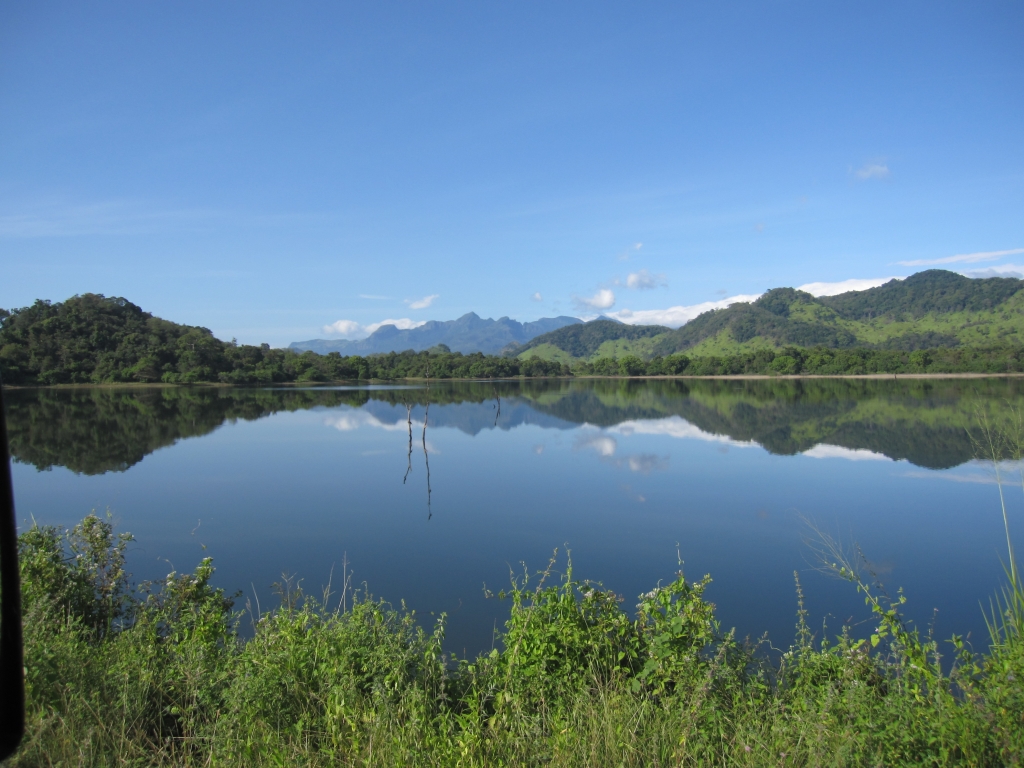
Turning off from the main road we drove down a gravel road that led through the Weheragalagama village, over the tank (reservoir) bund, down the causeway where the water from the tank spill drained, pass the Tree Hut Corridor to two small villages located deep in the forest reserve.  As we drove along on the bund the Himbiliyakade Forest Range stretched parallel in the west directly across the tank, forming a chain of green undulating hills with the Knuckles Mountain range providing the backdrop in the far distance.  

The hills of the Himbiliyakade Forest Range mirrored on the Weheragalagama tank

The sky was a vast blue empty nothingness with a few scattered cirrus clouds floating lazily like strands of white candy floss let loose by an errant child.  Brahminy kites and a pair of white bellied sea eagles soared and glided on air currents rising from the tank.  Without doubt they were keeping their eyes out to snatch any unwary fish that came up gasping for air.  Closer to the surface by the water with similar intent were egrets, woolly neck storks, lesser adjutants, white-throated kingfishers, stork billed kingfishers, common kingfishers, pied kingfishers, painted storks, pond herons, ibis, spoonbills, bitterns, water hens, terns, pelicans and many more avian denizens. They were also keeping somber vigil to catch whatever unsuspecting fish that came anywhere near them. 

Brahminy Kites circling over the tank
Great Egret

Lesser Adjutant Storks


Black-winged Stilts

Spotted Redshank
In the water itself there were annhingas (snakebird or oriental darter), cormorants, otters, crocodiles, snakes and water monitors waiting to grab or chase down any piscine that was stupid enough to come anywhere close to them.  And then representing the most predacious and voluminous fish eater of them all were a few local fishermen laying nets from their colorful outrigger catamarans.  


Annhinga aka Snake Bird or Oriental Darter and a Grey Heron

Water Monitor
Together this consisted of a four-pronged attack on fish for consumption from that particular body of water alone.  Taken from a global context it is a wonder how fish ever managed to survive for over 400 million years since the Devonian Period—when they got really numerous or in the jargon of evolutionary scientists “radiated,” when all these predatory avian, reptilian and mammalian fauna had a passion for eating them!  Going by the great demand for fresh fish in nature, Sushi must be the first and most popular fish recipe in the world and it was definitely not invented by the Japanese—unless of course the Japanese could trace their ancestry to a kimono dressed piscivore from the Devonian Period.

The Defender crossed the causeway splashing over the shallow puddle of water that had seeped from the spill. On the other side the road had several large potholes and corrugations created by the last monsoon rains.  The Defender with its spring suspension rocked and bucked like the ark must have done during the deluge.  To everyone’s relief the road smoothened out soon enough and we came to where the road cuts across the Tree Hut Corridor.  Here it stretched straight up to the horizon and disappeared over it.  That sight for some reason never failed to invoke in me a yearning for the infinite wetlands of my childhood that are no more.

The road that cuts across the Tree Hut Corridor
Making a right turn and crossing a ditch we head off-road up to a tree where a large and comfortable tree hut had been constructed by us.  The most distinguished guest we had in this tree hut was the former U.S. Ambassador to Sri Lanka, the honorable Patricia Butenis, an ardent and passionate environmentalist and animal lover.  

Arriving by the Tree Hut
Turning the vehicle around, I reversed and parked it underneath the tree.  But before anyone got off the vehicle it was important to scout the area to see whether any elephants were around.  The tall Mana grass (Cymbopogon confertiflora) that grew tall was very effective at hiding elephants.  Several times we had narrowly escaped bumping into one when getting off the vehicle to climb up to the tree hut.  The front bumper offered a good vantage point to scout the area to make sure there were no elephants lurking nearby. 

The tall Mana grass hid elephants very effectively
Once it was confirmed that there were no elephants I allowed the group to get off and climb up to the tree hut.  Everyone found a comfortable spot with a good view of the jungle and sat down to wait for the elephants to show up.  The film crew was anxious to film how elephants and people reacted to each other as they both moved through this corridor.

People are allowed to alight and climb only after checking for elephants nearby
Climbing up to the Tree Hut a la Swiss Family Robinson
In Sri Lanka the relationship between people and elephants goes back several thousand years.  The elephant is viewed as a living cultural and religious icon because of the important role it still played in the culture of the country.  But today this relationship had reached a new low, which is human-elephant conflict that resulted in the death of over 200 elephants and about 80 people annually.  For the past 16 years the SLWCS has been addressing this issue by developing innovative measures to mitigate human-elephant conflicts under its land mark and international award winning project, Saving Elephants by Helping People (SEHP).  These efforts have slowly and gradually brought dividends to the people and elephants at our project site in Wasgamuwa in the Central Province of Sri Lanka.  Earlier enemies now tolerated each other to an extent that it was possible to observe people and elephants using a corridor and not trying to kill each other.  This was an incredible sight to see especially on days when men, women and children traveled back and forth from school and work on this road while on either side there were elephants.  These were the interactions that the volunteers were going to observe and record and the crew from Greener Media hoped to film.   The SEHP Project in 2008 received a prestigious UNDP Equator Initiative Equator Prize for its outstanding efforts to alleviate poverty through the conservation and sustainable use of biodiversity.  

Receiving a UNDP Equator Initiative Prize in 2008
By the time we settled ourselves in the tree hut it was about 4 pm, which was just about the right time, because as the sun started to sink behind the hills and the day got cooler elephants began to move out of the forests and head towards the grasslands.  Up in the tree hut the film crew set up their camera and sound equipment to get into instant action as soon as the first elephant showed up.  It was vitally important to be quiet and I had insisted on it and had imposed while in the tree hut any and all conversations or anything anyone had to say had to be whispered or mimed.  Unless of course, it was an urgent matter such as an elephant was trying to climb up the tree!  The tree of course had been selected to ensure that an elephant could not push it down. 

Elephants had very good hearing and they would get alarmed at the merest sound of our voices.  It was not to our best interest to alarm them before they came close to the tree hut.  Most wild animals were easily frightened and took instant flight at the sound of the human voice.  I’m not surprised at all! There are a few people I know whose voices scare the hell out of me too!  Elephants were no exception unless they were otherwise occupied, such as charging to attack or when raiding fields and homes for food.   Then no amount of shouting or screaming would deter them and the only hope was to have a good exit plan.  It had been suggested that if an elephant made a determined charge while you were on foot to leave something behind as a memento while attempting to get away.  The shirt or the backpack left conspicuously behind would suffice since there really wouldn't be enough time to discard the pants and the time it would take to do so would be counterproductive—unless of course one was wearing a sarong.  Actually this had worked—meaning not jettisoning the lower garment but leaving something behind.  It had helped to distract or divert the attention of a charging elephant.  I had once experienced this quite accidentally and quite unintentionally of course, at Lahugala in the Eastern Province of Sri Lanka.  I had not repeated it again, nor do I have the intention of doing it again either.  Therefore I cannot guarantee that it works always. 


Twenty feet above the ground out of the reach of elephants we whispered like conspirators, and mimed to convey complex ideas using facial expressions for which generally actors receive academy awards.  Phil who was the producer as well as the cameraman whispered, “How long will we have to wait before they showed up.”  

“That is hard to say but generally by around this time they should start coming out of the forest,” I replied. 

“Are there days that they never show up,” Jesse inquired in a bass whisper that reminded me of Barry White.

“Of course some days they don’t show up, but hopefully today will not be one of those days.”

The SLWCS gathered data on human elephant interactions from the tree hut so the three volunteers got prepared to record their observations that evening.  This was one of the several field activities that volunteers helped us with.  Emma had the clipboard to record data while Rachel and Samantha would observe and report whatever the activities they observed. 

The U.S. Ambassador pointing out at elephants while volunteers: Emma and Samantha record their observations

A part of a herd with a small calf walking away from the Tree Hut

The reason to gather this information was to look at the temporal dynamics of how elephants used the Tree Hut Corridor and how important it was to their annual ranging cycle.  Because people and elephants both used the corridor we wanted to find out the effects and impacts they had on each other.  It was an unusual and incredible sight to see. Groups of children walked to school or home on this road and on either side there were elephants!  Only very rarely had we observed bulls attempting to charge or attack people. On these rare occasions the bulls had been mostly bluffing and the people too have also learned to behave sensibly during these times.  Probably that is why so far there had been no untoward incidents.  On several such occasions when SLWCS field teams had been present they had intervened to safeguard the people by transporting or escorting them to the safety of their homes in our field vehicles.     

A Cyclist on the road that went across the Tree Hut Corridor
The crack of a snapping branch sounded very loud in the stillness of the late afternoon.  It completely halted our whispered discussion in mid-conversation.  I gestured hurriedly for everybody to be quiet and we gazed in the direction the sound had come from.  Suddenly there was another crack and then another and soon all that could be heard were elephants feeding in the forest.  They were browsing and grazing and the sounds gradually got louder and louder as they moved towards where we were.  Everybody kept scanning up and down the forest edge to spot where they would emerge from. 

The film team immediately got their equipment ready and the volunteers took up their positions to make observations and record data.  Rumbles from the elephants reverberated over to us interspersed with the peculiar squeaky noise they made.  This was a high pitched sound I have heard members of a herd make when they were relaxed and content or when they were nervous and stressed.  The piercing trumpet calls set our hearts thumping and bodies tingling with adrenalin.  As the sounds of feeding and calling got closer it became apparent that it was a large herd and they were spread out as they fed and moved towards the tree hut.

An elephant that was barely visible through the trees gradually drifted into view, its sinuous trunk snaking around bunches of grass that it scythed effortlessly and transported to its cavernous maw.  Just behind it was another elephant similarly occupied and if they continued would come right underneath the tree we were waiting.  

An elephant emerging from the forest

For such large animals the fluidity in their motions is incredible to watch
As they fed some of them would throw grass and dirt over their backs.  This must be grass that must have tasted bad.  I wish I could do the same when eating out at a swanky restaurant.  The dishes that were not up to expectations could be sent sailing over the shoulders. Yikes! This dish tastes awful, here it goes.  “Sorry old chap did not mean to festoon you with this delicate gourmet dish.” Just imagine the fun on a day when several disgruntled customers were around at the same time.  It would be like a Greek wedding!  As more of them appeared—elephants I meant and not disgruntled customersthe ones in the lead would raise their trunks to check for danger.

As they grazed they would throw grass and soil on to their backs

A part of a herd emerging and a lead elephant checking for danger
About half the herd had come out into the open when in the distance emanated the distinct sound of a tuk tuk also known as a Bajaj three wheeled vehicle.  With its small two-stroke engine sputtering and straining the tuk tuk appeared far away headed in our direction and would shortly go past the tree hut.  As the tuk tuk got nearer and louder the entire herd became completely silent and then there was the sound of them rushing back to the jungle.  One minute they were there and in the next they were gone.  The film crew and the volunteers looked deeply disappointed.  Due to their despondent state I had to remind the girls to note down what they had observed. 

"What do we do now?” Phil asked miserably.

“We wait, the herd will come back.” I retorted.

Likewise in a short while we could hear them feeding and moving in our direction.  This time though they had moved a bit north from where they were before.  Earlier they would have come right underneath the tree hut.  But now they would appear a little bit further away from where we were. While we could still see them it was not as good as if they had been right underneath us.  Peering through the canopy we attempted to get a visual of the elephants.  I was staring at a place where I could just make out an elephant when I felt a light tap on my shoulder.  It was Jon to point out where most of the herd had come out from.  It seemed they had moved even further away and were hardly perceptible from the tree hut especially for filming. 

Phil looked at me and said in a dejected tone, “They are a bit too far to get good footage.” 

It seemed at that range it would not be possible.  I had not expected them to move that far when they returned.

“What do you suggest,” Phil asked.

“It depends on you, and if you are courageous enough.” I replied. 

“What do you mean?”  Phil asked.

“We could approach them in the vehicle.” 

“Why do you need to be courageous to do that? We are in a vehicle...will be safe...right? Or we are not? Jon asked hesitantly.

“Well... not actually inside.” I remarked casually.

“Oh! What do you mean?” Phil asked looking me straight in the eye probably having a presentiment about what was going to come. 

“What I had in mind was for you to be outside.” 

Jon’s expression was quizzical, “you want Phil to be outside the vehicle when we drive up to the elephants?”

“You and him both”

“What the ...” Jon exclaimed. 

“Alright, let me make it clear.  You both will up on the roof of the Defender and the rest of us will push it up to the elephants.  This way we will not cause any alarm by driving up to them.  There it is. What do you guys think? Are you up to it?” 

Phil grinning, “You have some brilliant ideas I must say.”

“That is just terrific,” Jon retorted.

So how often have you done this? Rachel wanted to know. 

“I have lost count,” I grinned. 

Emma, Samantha and Rachel demanded that they also wanted to be on the roof with the guys. “We’ll be good and not be a disturbance.  We will behave,” they promised.

“How you behave does not matter.  It all depends on how the elephants will behave. I remarked.

“How would they react?” Jesse inquired.

Elephants were unpredictable as much as any other animal, human being or politician was. There was no way of saying how an elephant or a herd would behave under a given situation. There was only one way to find out. 

Let’s do it and see how they’ll react,” I said climbing down from the tree hut.  

A roof top view of elephants

Phil climbed onto the front bumper and from there to the mud guard and sat himself on the front crossbar of the roll cage on the roof.  When he gestured that he was ready I passed the camera up to him very carefully.  Behind Phil to the side Jon knelt down with the recorder and the shotgun microphone.   Jesse, the three girls and I pushed the Defender towards the elephants.  From the driver’s side window I steered it while pushing against the window sill.  After the initial effort the slightly inclined road and its own momentum kept the car moving forward without much effort on our part. 

The gravel crunched loudly underneath the wheels and our bare feet.  The crunching gravel and our labored breathing were the only sounds that were audible as we pushed the car.  The mobile roof top elephant-cam slowly and gradually inched forward and got close to the herd.  I kept looking up frequently to make sure that we didn’t roll the vehicle with Phil and Jon on the roof right into the midst of the herd.  Honestly, I wanted this documentary to get completed.  We needed it to create global awareness about the plight of the Asian elephant. A pancaked film crew would be of no help.

Filming and observing elephants from the roof
Remarkably the herd did not pay much attention to the slowly approaching vehicle.  One or two elephants looked up and stared at us and then went back to feeding as if a Defender cruising on human power was something they were quite used too.  When we got to about 30 feet from the herd I called a halt.  It would have been possible to get much closer but I was concerned.  There were too many people on the roof to clamber into the vehicle hurriedly if an elephant took offense at been pried upon from a Land Rover roof!

A part of the herd emerging from the forest
Phil filmed the herd until failing light made it impossible to shoot anymore.  Some elephants ventured very close to the vehicle.  He managed to get some remarkable close up footage of elephants and also of pedestrians, people on bicycles, motorcycles and the ubiquitous and raucous tuk tuks going by the herd.  Whenever one of these intruders came along, the herd would just clumped together and remain silent hiding behind tall grass or scrub.  These people had either walked or driven by quite oblivious to the fact that a herd of wild elephants were just a few feet away. 

A noisy Tuk Tuk driving past an elephant

A Tuk Tuk with lights blazing driving by a herd that is hardly discernible
  
One of the feeding elephants had ventured quite close to the vehicle

To approach people this close while feeding means the elephants felt comfortable with the situation.  Notwithstanding how comfortable the people felt though!
After sunset only the stupid and the drunk venture on foot in areas where elephants frequent.  An interesting fact is, of the eighty odd people that are killed annually by elephants in Sri Lanka, the majority is men and of these men the majority had been intoxicated at the time.  The false sense of bravado that intoxication imbues had been the main cause for their deaths.  According to the accounts of sober companions who had been present—these men had gone to challenge the elephant and/or refused to seek safety which had of course led to their unfortunate demise.  It is in fact quite disconcerting even to imagine this ridiculous situation: where a puny man is telling a 10,000 pound elephant to bugger off the road.

A man walking past a herd that had clumped together and are hiding in the grass
On a pitch black night we were driving to one of our field stations located deep in the forest. The night was so dark it felt like a solid wall.  Coming around a bend—we gasped in disbelief because illuminated in the head light beams were two men.  They were drunk to high heavens, stood on the middle of the road holding on to each other, and were staring in our direction with wide unfocused eyes. The headlights had probably blinded whatever visual faculty they had in their alcohol infused state.  Good thing we don’t believe in metaphysical apparitions.  Otherwise the manner in which they just popped out of the darkness like that would’ve scared the hell out of anybody. 

What was even more incredible was the fact that we had just passed by several bulls that obviously these two men must have walked past too.  This goes to show the leniency of elephants sometimes towards idiot and drunks or just shows that the guardian angels of drunks and imbeciles must work overtime.  We hauled in the two inebriated nut cases into the Land Rover to drop them off at their homes in the village.  I feared we will get high just breathing the fumes they were emanating.  By the time they were dropped off at their homes—assuming they were their homes but going by the commotions we heard as we left it could be that they had gone into the wrong homes—everyone was practically gasping for air.   

This evening fortunately for us after dusk ended no one came on the road—no not even drunks to disturb the tranquility of the elephants and us.  In the dark it was great to sit under that vast lustrous canopy and listen to the sounds of the herd feeding contentedly.  The years of hard work resolving human-elephant conflicts in this area by the SLWCS seemed to have paid off at least for these elephants and the people of this area.  But it is tenuous at most.  There are undesirable elements with vested interests, lack of knowledge and ill-planned agendas always conspiring to destroy this hard won coexistence.   That is why it is important for us to continue to monitor as well as work with the local communities and authorities to ensure that we save this microcosm of where people and elephants seems to get along, for posterity.  The volunteers are important and vital allies whose help and contributions are critical to make these efforts successful.       

Thank You volunteers!