Tuesday, September 10, 2013

The Lahugala Kitulana Incident: Saved by the Shoe (Part III Conclusion)

During dusk at the Kitulana Tank a tightly bunched herd rushing off to the safety of the jungle 
Prologue

In 2004 the Department of Wildlife Conservation requested the SLWCS to establish a project to mitigate human-elephant conflicts in the remote Lahugala region.  During one of the preliminary field visits we encountered an injured bull elephant that disappeared soon after we had observed it.  We tried to help the Department of Wildlife Conservation personnel based in Lahugala to find this elephant so that a veterinary surgeon dispatched from their head office in Colombo could treat it.  This is an account of what happened when we went in search of this injured elephant.  While it’s true that a shoe was involved in this incident it had nothing to do with Cinderella’s story.  Though to have had a fairy godmother when things looked pretty desperate during a faceoff with a bull elephant would have made this a very nice fairy tale.

The Back Story:  After the project meeting we headed back to the place where we had seen the injured elephant.  To our disappointment it was not there.  So we drove slowly down the road scanning the jungle on either side looking for it.  As we were passing by the Kitulana Tank the two game guards spotted four elephants far away in the distance, one of them was in the water.  It was known that injured elephants liked to stay in water for its calming and soothing qualities.  Parking the Defender by the side of the road we decided to walk up to the elephants, to check whether the one in the water was actually the injured elephant that we had observed earlier on our way to Lahugala.  Now, we had no idea how serious the injuries of the elephant were, but most probably they were not as bad as the serious brain hemorrhaging we must have had to go traipsing in the open towards a group of wild elephants.

We must have walked at least 200 meters or more on open ground to get to the elephant that in our minds—at least in the brain dead part of it—we were convinced was the injured elephant.  Induced by a latent suicidal gene that we all must have inherited from some common ancestor we had walked right up to the unsuspecting bull elephant.  Wonder how long the ancestor survived with such a trait?  Apparently long enough to pass it on very generously to us. 

Standing at various distances and angles from the bull, we did our best to get a glimpse of its’ front left leg. The elephant quiet unconscious of the fact that there were several people in the back gawking at its very generous posterior very frustratingly kept the same position. 

After several minutes—it felt like eons—of this very uncooperative behavior, the elephant started to shift but unfortunately towards the wrong direction.  In the meantime I had been frenetically taking photos worried about lighting conditions when due to the deepening dusk the automatic flash popped out with a click and went off. 

The elephant while feeding had turned slightly right angle to us when the automatic flash went off
The elephant now standing slightly right angle to us immediately noticed the flash go off and flinched as if it had been struck a physical blow.  For a Nano second the elephant and we stood frozen in time.   With not many options available we stood our ground and waited to see how the elephant would react. Would it decide to run or attack? 

The elephant just as the flash went off
Part III - Conclusion

It took less than a millisecond for fate to give its verdict and the verdict was:  The elephant just erupted.  He reminded me of Mount Vesuvius—from the stories I had read about it of course.  Letting out a mighty roar and blowing air out like a turbine engine he swung around with head raised ears spread, trunk curled and glared in our direction.  Whatever memory that connected a camera flash to its past seemed not complimentary at all to humans, or turn out to be a boon that would assure us coming out of this situation intact.  As far as injuries were concerned no surprises there—the elephant was in perfect physical condition.  It did not have one unhealthy molecule in its body as far as I could notice other than for the unhealthy thought to pulverize us all to the ground. 
It turned  on a dime while releasing air like a Pratt & Whitney turbine engine
Stretched along the edge of the pool transfixed to the ground we stood and ironically the elephant seemed similarly afflicted. There was no doubt as to who will come out from this staring match unscathed.  Meanwhile courting annihilation I hastily took photographs.  What with trying to balance on an uneven ground trying to breathe into lungs that seemed to have completely shut down, and control hands that shook and shivered as if I was out on a first date (not with the elephant) the photos came out pretty blurry.  The accompanying photos are a testimony to this.

Suddenly a lot of shouting came from the side.  It was Ari and Jeggan, the two game guards, they had apparently recovered from whatever trance they had gone into and were waving their arms and yelling as if to shoo away the elephant.  Perplexed I wondered what they were trying to do.  Did they really think they could shoo away a 10 ton elephant as if it was a barnyard rooster!  But quickly realizing what they were actually trying to do, soon we were all yelling and shouting to frighten off the elephant. 

Standing at the forefront of this action Chandima and I shouted and waved our arms at the colossal pachyderm—we must have looked as ludicrous as two Lilliputians challenging Gulliver to a fist fight.  Actually it was not shooing chickens but playing chicken what we were doing—trying to frighten the elephant before it attacked us by bravely trying to act more dangerous than it was. 

The big question was whether it would buy it? Would it take us as a serious threat and scram?  Given the predicament we were in there was not much that could’ve been done either other than to stand our ground, which again is rather easy to say than actually do it then. 

It was a terrifying situation.  The first instinct was to run but there was no way we could have outrun an elephant especially in those conditions.  The elephant stood there—looking flabbergasted.  Probably couldn’t believe that a bunch of puny humans dared to yell and scream at him—who was just minding his business until rudely disturbed by an idiot pachyderm paparazzi.   I was yelling my head off as well, all the time thinking whether all this shouting would encourage rather than discourage the elephant?   

My doubts seemed to be justified when the elephant started to get larger through the view finder!  It charged from the water causing small tidal waves to erupt and made loud sloshing and squelching sounds as its’ pillar-like feet smashed through the mud.  It suddenly dawned on me that whatever escape plans that I had been thinking about, now was the time to execute at least one of them.  While these thoughts raced through my mind I heard the others still shouting and yelling at the elephant. They were really going at it.  

The Charge
In a last ditch effort I bent down to pick up my shoes.  At least they’ll say “he made a valiant effort to escape before the elephant got him.”  As I grabbed the shoes in one hand with other hand clutching the camera my glasses slid off and fell to the ground. 

Frantically I snatched at the glasses with the hand that was holding the shoes and one of the shoes slipped out.  What was I to do? Leave the shoe and run to live another few moments, or get squashed into my shoe and hope to be reborn as a pair at Payless Shoes?  

In the meantime the elephant who despite all the shouting and yelling seemed to have doubled its efforts to get to know me personally.  He in fact as I had pondered—seemed to be encouraged rather than discouraged by the shouting and yelling.  It must have been a rugby flanker in its previous life.  As I was struggling with these thoughts a blur went past me and it was Chandima racing hell for leather.  That boy could sprint!  Watching his receding form made me realize that I better follow suit if I wanted to come out of this alive however remote it seemed right now.  There was no time for heroics anymore leaving the shoe where it was I turned around and fled.  

I ran over the craters and corrugations on bare feet as if I was a hydroplane, which only a little while ago I had walked with such care.  I had the urge to look behind but knew it was not advisable since the last thing I wanted was to trip and fall.   I ran behind Chandima and could not even get close to him.  Years later he told me that his only objective was to stay a few feet ahead of me to avoid getting trampled by the elephant.  Now that is what I call a heartwarming confession.

Amidst the yelling, shouting, ground reverberating thudding and ear piercing trumpeting I sped away as if the yakkas (demons) were after me.  Not to demonize the elephant but it felt like the biggest yakka of all time was coming after me.   As fleet footed I was, I knew for a fact that my speed was a like a tortoise’s compared to the gigantic strides of the elephant that was probably already inches behind me.  How I wished to be anything other than a tortoise.   I ran towards the trees that seemed to be receding.  

While sprinting I was imagining what it must feel like when an elephant whacked you with its trunk?  It was imminent and probably a few centimeters away from happening.  Probably the first whack will make me airborne and then who knows I’ll be able to glide up to the tree tops.  A devoted guardian angel or a fairy god mother with a magic wand is what I desperately needed now.  I urgently needed the power to levitate or to have the single shoe in my hand transformed into a Lamborghini in a flash. 

Amidst these frenzied thoughts I ran for my life.  After it felt like I had run the New York Marathon ten times over it suddenly occurred to me that the elephant was taking its time to catch up?  It seemed highly unlikely that a guardian angel had showed up at the last moment and even more improbable that I must have acquired super hero abilities all of a sudden to outpace an elephant!

Then I became aware that the shouting and yelling had stopped!  The first panicked thought was the elephant had stepped on someone else.  Damn! I stopped immediately doubled up breathing hard, hands resting on my knees but hesitating to look behind fearing what I might see.  

In front Chandima was sprinting at Olympic speed apparently determined to stay ahead of me!  Having no other choice I forced myself to snatch a quick look to see what was going on behind me.  Nishantha, Ari, Jeggan and CC were standing wherever they had scattered to and were staring at something.  Relieved that none of them looked like they had been pancaked to the ground I followed their gaze and it was an improbable sight. 

The elephant had given up chasing and was heading away from us towards the jungle at a fast walk.  I was so thankful for the reprieve but wondered what had made it change its’ mind? Gasping for breath I walked back while watching the bull briskly head towards the forest swinging its head and waving something in its trunk.  

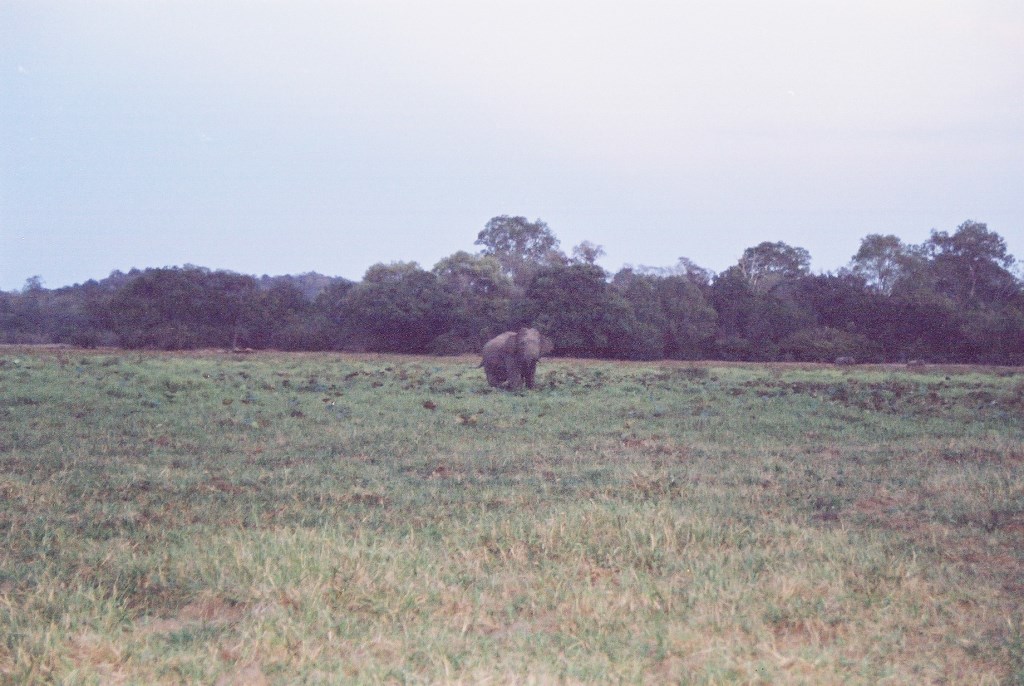
The elephant walking away
What was it holding in the trunk?  Then I noticed what it was. It had picked up my shoe and was waving and twirling it around.  The shoe had saved my life or for that matter all of our lives that day.  If not for it, it would have most probably been me that the elephant twirled, waved, kicked around, and practically amalgamated into the rich littoral plain of the Kitulana Tank that evening.  I was so glad that I had washed my feet before putting on those shoes that day.  It would have been rather tragic to get stepped on by an elephant for having dirty feet.  As the elephant headed for the jungle I suddenly started to miss my shoe knowing that I’ll never see it again.

My shoe and the elephant...going, going...

...and just about to be gone for ever.  So sad 
Rohitha who suffered from a knee problem had wisely stayed at a safe distance while we lacking in cerebral faculties were walking up to the elephant.  When the elephant charged he had managed to get to the safety of the tank bund quickly.  The rest of us adrenalin coursing through our bodies walked back to the bund talking excitedly how a shoe had saved us.  

At the bund we stopped to discuss this amazing incident with Rohitha while Nishantha continued on to the Defender that was parked below by the roadside.  When Nishantha walked up to the vehicle the elephant stepped out from the jungle right in front of him.  With the vehicle still locked Nishantha was unable to get into it.  Having no other choice with alacrity he clambered on to the roof that probably won him the respect and admiration of a group of macaques that were lounging nearby. 

Wow! This guy is definitely one of us
The elephant crossed the road just a few feet away still carrying the shoe and disappeared into the jungle on the other side.  Fortunately it seemed none the worse for its experience either.  Probably like one of Cinderella’s fat stepsisters it could not wait to try out the shoe, otherwise it could have plucked Nishantha of the roof like a ripe pawpaw. 

When we got to the vehicle, Nishantha was still up on the roof turning this way and that way like a rooster on a weather wane worried that the elephant will reappear any moment.  Our routine field trip had turned out to be adrenalin generating wild adventure which could have quite as easily ended tragically.  But then this is more or less how it is every time we are in the field.  This is the wilderness that we are making every effort to protect and conserve.  How bland and inglorious our lives would be if not for the incredible wildlife and their habitats.  This is what the Sri Lanka Wildlife Conservation Society fervently believes and is sincerely committed to conserving for the future.  But it also must be said, that saving the environment, especially our vulnerable wildlife and their habitats is everybody’s responsibility as well.    

During another trip to Lahugala observing elephants the proper way. 
Postscript

At the time we were initiating the Lahugala Project, Sri Lanka was facing severe terrorist problems.  On several occasions when traveling in the Lahugala area, we had been either 5 minutes late, or early, our Karma barely averting us from becoming victims of remotely detonated road side bombs. 

Just to give an idea of what it was like to travel during those days, once we were returning from Pottuvil in the late afternoon and had just past Sengamuwa when a mortar fell into the jungle not even 30 meters away exploding with a muffled thud.  The terrorists had suddenly decided to attack the Special Task Force camp that was nearby.   Smoke, dust and debris mushroomed through the trees and even engulfed the road we were on.  The acrid smell of explosives was suffocating.  We sped away before a mortar fell on top of us.

Wherever we travelled during those days it was in such a climate of death and mayhem.  Not only to Lahugala but even to the more remotely located Somawathiya Chaitiya National Park where the SLWCS erected a 3 kilometer electric fence to protect the pilgrims and the temple from elephants.  It did not matter where we went those days there was always the specter of annihilation hanging over us.  And yet, just like a Romeo who was enamored by a Juliet, from a very young age we were smitten by the wilderness—so when it beckoned to us during its time of need we ran to its aid putting our lives within inches of the maws of death.  Several times I’ve had to evacuate the field teams from our project sites in Kalpitiya and from the East due to intense terrorist activity. 

For the Department of Wildlife Conservation personnel it was an even worse situation.  Some of the parks were massive and had become havens for the terrorists and to other criminally minded elements to conduct various nefarious activities.  Under staffed and ill equipped they could patrol and protect animals only within a very limited area.  So to go looking for an injured elephant that was still very mobile under those conditions was an impossible as well as a highly dangerous task.  In fact they would have been blatantly courting death. 

Then there was the issue of actually trying to find the elephant.  As seen from our experience to go searching for an injured elephant that could move around was a tremendous challenge and dangerous as well.  To find elephants is easy, but to find a specific elephant in the wild was like searching for a slightly reddish red herring in the red sea. 

And even if one wanted to go in search of an injured elephant during those days of turmoil, it would have entailed taking deadly risks—and these risks were not from wildlife but from terrorists.   Not only were they severely handicapped by the terrorist activities to perform their duties but as government officials the wildlife department personnel were attractive targets as well.  In the 33 year old conflict several wildlife department field personnel were killed and some of them I knew personally. 

The injured elephant that we went in search off, months later the wildlife rangers found its dead body in the jungle.  It was identified from its injured front left leg.  It had eventually succumbed to its injuries.  This was just one elephant.  The reality is several hundred die every year due to human elephant conflicts in Sri Lanka.  This is why we are so committed to maintain what we had managed to accomplish at our project sites in Wasgamuwa.  Through the measures we had developed it has been possible to create an environment of coexistence in a once conflict driven area.

The injured elephant that was found dead months later
It is a wildlife department regulation to burn elephants that are illegally killed as a precaution to prevent the spread of infections as well to discourage people from taking body parts.  The game guards mentioned that they were unable to incinerate this particular elephant because they were scared that the smoke from the burning carcass would have provoked an attack from the terrorists. 

Fortunately those days of death and mayhem is over and Sri Lanka today is a land of peace, but the challenges to save our wildlife still persists—these challenges have only changed in form but not in their magnitude.

With deep gratitude and respect I dedicate this blog in memory of all the Department of Wildlife Conservation personnel who had sacrificed their lives to protect our wildlife and their habitats.  May they travel in sublime tranquility through Samasara until they attain Nirvana. 

Something to muse over: According to Buddhism if a person is not fortunate to be born in his or her next life as a human being, then the Prarthana* is they will be reborn as an elephant.  This is because Buddhism identifies the elephant as the noblest of all animals, as well as the most human-like non-human being in the world.    

*wish, prayer or seeking

Saturday, August 24, 2013

Mandi’s Reflections on Interning with the SLWCS in Wasgamuwa

Mandi (Amanda) Roberts is a student currently studying for a BSc (Hons) in Wildlife Conservation and Ecology at the University of Chester in England.  For two months from May 10th to the first week of July 2013, Mandi did a study on human elephant conflicts at the SLWCS project site in Wasgamuwa for her 3rd year dissertation. This is Mandi’s story about her internship experiences in Indonesia and Sri Lanka.


Mandi Roberts
For Learning in the Wider World, my placement was with The Royal Society for the Protection of Birds (RSPB) project at Harapan Rainforest, Sumatra. I was due to follow this placement with 5 weeks in Sri Lanka with the Sri Lanka Wildlife Conservation Society (SLWCS) to conduct research on Human Elephant Conflicts for my third year dissertation.

Indonesia

I found organising the placement with RSPB in Sumatra very stressful from quite an early stage; there was a distinct lack of communication and lack of urgency to respond to emails which I found unacceptable considering the size of the organisation. Despite volunteering with my local RSPB reserve for over 18 months, I had never experienced that level of un-co-operation before. I had felt, prior to leaving the UK, that there was negativity about the placement despite opportunities to re-arrange it and offering to cancel or postpone the trip.

RSPB Field House in Harapan, Sumatra
I felt as though I was a hindrance before I had even arrived but, because it was such a good opportunity, I decided to put those negative feelings to one side and tried to make the most of it.  It became apparent that those negative feelings would be harder to shake; I found out that they had not arrange transport for me from Jambi airport to the camp (I at least had the initiative the night before to email again to ensure there was transport), the people whom I was supposed to be working with were all off on holiday for most of the first week—which would not have been a problem but I had asked them if they wanted me to postpone the trip at any point, and there was no formal plan for me to start when I arrived.  This, along with substandard and subsiding accommodation enhanced my feelings of being a burden and a hindrance.  Once the Head of Harapan project had returned to camp, he referred to me as a ‘problem,’ I assured him I wouldn’t be a problem but he repeated this comment over a few days to numerous other people. I could not tolerate this level of unprofessional conduct, it confirmed all my previous negative feelings and after a long talk with my mum about my options, I decided that it would be best to leave that placement early. I spoke to the founder of SLWCS and he was more than happy in bringing that part of my trip forward. After reading over my journal entries, I realised that I had not taken responsibility for my own actions in regards to cancelling the trip when I had the chance; I found, reading them back to be very interesting; maybe it was a self-fulfilled prophecy that the Indonesian leg of the trip be doomed to fail.

Sri Lanka - the view from the SLWCS Field House
Cultural Immersion – from Schools to Celebrations

Upon arriving at the field camp in Wasgamuwa, I felt instantly at ease and welcome despite the 7 hour drive from Colombo and 1.30 am arrival.  I didn’t expect to come to Sri Lanka to teach children, my first day was at Knuckles Mountain Range with around 60 students from 3 different schools—ranging from very poor to reasonably wealthy and primary to secondary. Two of the schools had English teachers but found that those children did not want to interact, but the children from the very poor school were smiling and very much enthusiastic about their day—for many of them, this was their first field trip, despite Knuckles being on their doorstep.

Handing out field work assignments to students
I assumed that if you live in the towns or cities, you had to make an effort to visit the great outdoors, whereas people who live in rural communities had it for the taking; what I found was that for most people in these rural communities, working 7 days a week and tending their farms meant they had little time to visit such places.
 
Distributing resuable bags* with fellow volunteer, Adam
*The reusable bags are made from rPET and were a donation to the SLWCS from Onya Innovations based in South Freemantle, Western Australia. 

It was daunting experience particularly as I have no prior experience in teaching or working with children. I brought a few extra things with me such as binoculars and a magnifying glass and introduced them to tree rubbings (in order to get the detail of the bark)—something I did as a child and naïvely assumed would be a standard practice in schools.  What surprised me the most, was not the children’s reaction to these things, though they did seem eager to try out them out, but that the teachers were perhaps more interested than the children! They were initially quite reserved but with the reaction from the children, the teachers seemed to try and jump the queue to try out the binoculars!

A group of children working on their assingments

Another group working on their assignment

Observing and recording information about the natural world


Another group removing litter

SLWCS Project Manager, Chandima explaining the assignments
SLWCS Project Manager, Chinthaka assisting a group of students
The great outdoor classroom

Class of May 2013
I and a volunteer had been asked to teach English in a class by the principal of one of the schools; which we were happy to do. There were 50 students aged around 10-11 years old, the classroom was of a level of heat I hadn’t expected and the teachers just abandoned us! We did have the field manager for SLWCS, Chandima Fernando and Field Scout Veroni (who is a teacher in training) so we at least had people who could translate for us. As some of the students had been to Knuckles the previous Saturday, we decided to keep to the theme of food chains, with the understanding that the children have some knowledge of English and the natural world. Turns out they knew very little of both! It was quite difficult explaining that a dolphin isn’t a freshwater fish and that vampire bats aren’t fruit eating birds; but they seemed to enjoy themselves!

The students apparently enjoyed their English lessons
As it turned out the best way to communicate with kids is through smiley faces and thumbs up (they got a bit too overexcited with double thumbs up!); we decided we had pitched the lesson plan too high for the children, they did enjoy learning the English names for some animals, so myself and Chandima decided it would be best to start next time with these simple translations.

An endemic horned lizard (Ceratophora species) in the Kunckles

A Blue Mormon butterfly
It was the celebration for Buddha’s birthday and two of the staff members were Buddhist, so I asked if it would be ok if I attended the local temple to see what the celebrations would be like. Veroni’s family were responsible for the main gift of flowers and had previously picked several hundred lotus flowers, which all needed to be prepared (to look as though they’re in bloom) before being donated; so I and several of the volunteers went to Veroni’s home to help with the preparation. It was a very relaxing experience, it was nice to see how other religions celebrate and at what lengths they adhere to the philosophies; it was a unique experience that I was glad to see and I thoroughly enjoyed it despite my atheism! The day ended with a trip to the temple to give another gift of flowers and to light incense sticks; as I and the other volunteers were not Buddhists we only stayed a very short time as we did not wish to divert attention to the reason why people were there.

Siriya with a basket of freshly picked purple lotus flowers
In Situ Field Research

Their small hills are my mountains
I have gained some experience in field research through my degree; however, as I wish to be based outside the UK, I wanted to gain experience working in a tropical environment.  I found the hardest thing to deal with was the heat and humidity; which I expected but did not appreciate how difficult it would be. The actual physical work of the line transects, creating sand traps and monitoring the electric fence was fine, but it was made so much harder when I had to deal with the heat and the speed in which you dehydrate. At times I did find it too much, particularly when trying to catch up with the field scouts; I decided fairly early on that if they were going too far ahead then I could just slow down or ask for a break; I passed this onto the volunteers that turned up in subsequent weeks as I noticed that some felt too embarrassed to ask for a break. It took a good week to acclimatise and I did notice that some tasks we did during the first two weeks were a lot easier towards weeks 4 and 5. 

I’ve been shown how to do GPS mapping which has been great and has given me the enthusiasm to look into GIS courses once I’ve returned home. Though technology is not my strong point (in fact, I try to avoid it where possible), GIS is something that would greatly benefit my career after my degree.

The favourite part of my day involved elephant monitoring. This took place in the elephant corridor, which was situated between three villages; data surrounding people and their use of the corridor was collected as too was the elephant population, demographics and time they were in the corridor. It was a very relaxing part of the day; I would sit on top of the Land Rover and wait for elephants to show (which happened less often then I would have liked!)*.  

*Note: In the forests along the corridor elephants are present most of the time but whether they would venture out into the open is depended on disturbances. In addition elephant movements are also seasonal. This is why the observations made and data collected at the Tree Hut is important to understand the temporal dynamics of the elephants in this area.

After the busy morning of conducting field research, it was a great end to the day. I managed to see one herd of 14 elephants, which was amazing but at the same time I’ve seen the growing conflict between people and elephants. The people use government issued firecrackers (which are essentially fireworks) to scare the elephants off, however in some cases, this only aggravates an elephant more and at other times, they throw the firecracker at the elephants deliberately to injure the elephant. I knew of some methods prior to coming to Sri Lanka; however I wasn’t aware of firecrackers and found the practice of using them disgraceful.  I am aware that as a westerner, it’s easy to be so judgemental about the use of firecrackers as the people do deal with raids of their crops; however, what I did find through conducting surveys in the villages, was that many of the people found it difficult to describe the behaviour of elephants they came across in the corridor and their first thought would be to throw a firecracker.  If the people knew how an elephant behaved, then I think that HEC could be alleviated a lot quicker, as much of the time, elephants will not react to people providing they’re quiet and do not disturb them.

A herd of elephants by the Tree Hut
An elephant that had approached very close to the vehicle
One aspect that has been brought to the forefront for me is that I’m a lot more controlling than I would like to believe; I have previously been a store manager and used to staff members doing what I asked, but I had to remind myself that I was working with fellow volunteers and not my staff, so it was not my place to say what could and could not happen. I did find this interesting and something to be aware of—I just like things the way I like them!

I assumed my development of communication and interpersonal skills would revolve around the discussion of ideas to mitigate HEC and other matters related to conservation; what I found is these skills were developed through the raising of AD the Collared Scops Owl.

AD the Asiatic Scops Owl
AD arrived at SLWCS a week before I did*; I don’t have any experience working with birds never mind raising an owl chick! I found that they had him in awful housing (a metal bucket with a lid on top) and fed him the wrong diet (a diet of fish, when his species does not consume it) which I quickly changed.


Around the middle of my first week, we had returned to the field camp from a morning out conducting research to find that AD had diarrhea, possibly from being fed a diet of nutrient poor fish.  Naturally very concerned, I attempted to clean him up and asked for someone to get fluids and sugar water; it quickly transpired that AD was a lot sicker than we had realised, when he began to have fits.  He had between 10-15 fits, each getting progressively worse than the last, with three major fits that resulted in entire body convulsions; to hear a chick scream out of pain is a truly awful thing to experience—he got so bad that the others had to leave as they found it too upsetting and Siriya said he couldn’t see AD anymore, it was a horrible moment to experience as he had said what I was thinking. Chandima had tried to reassure me that AD would be fine, but I knew from experiences my friends had had with birds of prey, when they finally show symptoms of being sick, its normally too late.

AD as a downy owlet
I kept a vigil by AD; continuously trying to make sure he had fluids, a small amount of rehydration salts (Boots own brand!!) and made sure he was comfortable and able to sleep.
In my own astonishment, he managed to pull through! I felt bad for the times I wished for someone to put AD out of his misery—and was quite glad I had never actually said it! I knew that someone—anyone—human or owl—couldn’t have that many fits and walk away without any problems, and the next day, we found he was blind.

I stayed in with AD the day after his fits, we played games where I would put him at one end of my bed and make whistling sounds for him to follow; which he did, he seemed to enjoy the interaction. I hoped that because he was still so young (around 3-4 weeks old) he would be able to recover at least part of his sight as he grew.

As of writing, AD is living off a diet of crickets, grasshoppers and geckos (we are currently in very short supply of geckos in the field house!); his sight has fully recovered and is becoming more adventurous with his flying!

AD after he recovered from the fits
I’ve managed to gain communication and interpersonal skills through the request of hoona and mia (geckos and mice) forAD’s meals with Siriya, who only speaks Sinhalese! 


Gecko (Huna or Hoona)

Mouse (Mia, Miya or Meeya)
I’ve been discussing AD’s future and in the creation of new, bigger cages for him until we can find a permanent residence. It’s certainly not what I expected to find when I came to Sri Lanka, but for me the whole experience has been made by the presence of AD; I felt like I had to share his story.

AD 
I’ve raised this little owl from a chick, through a very difficult period when he was very sick and the knowledge that he would never be able to be released into the wild is awful, as that is where he should be. Though the trip so far has been incredible, AD has been at the centre of everything I’ve done here; leaving him behind is going to be one of the hardest things I’ve ever done.  He’s a ‘proper little owl’ now, though has a bit more growing to do and a very good reason for me to keep coming back to Sri Lanka!!


A memorable friendship. Mandi & AD (June 2013)

Sunday, August 11, 2013

Hannah's First Hand Experiences of Human Elephant Conflicts

Hannah Patterson is a student currently at the University of Birmingham studying Anthropology and Classical Literature and Civilization in a joint honours programme.  For a month, from July 1st to the 31st Hanna did a project on human elephant conflicts for her university dissertation at the SLWCS project site at Wasgamuwa.   This is her account of her experiences during the month she spent at the SLWCS project site.

Hannah Patterson
I did not really know what to expect when arranging to do my dissertation research with the Sri Lankan Wildlife Conservation Society. During the month I spent with SLWCS, I have been incredibly lucky to not only see elephants on 20 out of the 29 days but also many aspects of the reality of human-elephant conflict on a first-hand basis.                          

A large herd drinking at the drying out Weheragalagama Tank
Not having any previous knowledge about how elephant activity is scientifically recorded I was eager to learn about the techniques SLWCS used and what sort of results were been discovered.  Chandima, the SLWCS Field Projects Coordinator is clearly very knowledgeable in this field and took time to explain the society’s research procedures to me and their significance to understanding the human-elephant conflict in this part of Sri Lanka.                         

Heading out to the field with other volunteers and SLWCS field staff

With Chandima and the rest of the team gathering field data
The observations at the tree hut revealed how often just one section of the corridor was used by both humans and elephants and how dangerous it can be for both parties. It was interesting to see how different people reacted while travelling through the corridor as young children feared for their safety while attempting to walk home from school while often tuk tuk drivers seemed indifferent to the threat of a hiding elephant as they drove their vehicles at top speed making a lot of noise. 

The Tree Hut provided an ideal window into human elephant interactions
A family and an elephant using the corridor at the same time
Running away when the elephant begins to head in their direction

Two Buddhist Monks and a motorcyclist walking past a bull elephant

Two men cycling past several elephants

A man and woman looking alertly at an elephant while walking to their village

Two Land Master tractors driving past a large bull elephant
Seeing a herd of eighteen, with one of them a magnificent tusker and a couple of young calves, on my second day of been in the field was a truly amazing experience. However, when spending a night in the tree hut I was woken in the early hours to the sight of a bull elephant with a snare tightly wound around its trunk, probably making it impossible for it to eat. Chandima contacted the Department of Wildlife Conservation in the hope that they could do something for the elephant. However, I heard no news about this matter for the rest of my stay in Sri Lanka so I remain worried for the elephant’s health. 

A herd of 18 elephants under the Tree Hut

A part of the herd approaching the Tree Hut

The elephant with a snare around its trunk

A bull with a large cyst that had grown over a gunshot wound
Human encroachment into the elephant habitat was made further apparent while conducting research on the transect trails. It became obvious that some areas were being used by elephants more often than others. For example, the transect from the tree hut to the national park proved to be very popular as there were many samples to record, possibly because it is considered to be a safer route of travel by the elephants as it is hidden in the forested areas. Furthermore, throughout my time I saw dung with evidence of crop raiding through the remains of sweetcorn, cucumber, jack fruit, watermelon and rice. Not to mention that significant number of the samples we did record also contained large amounts of plastic and other rubbish.                                  
Poop Investigators analyzing elephant dung
Before arriving at SLWCS I had never heard of elephants entering rubbish dumps however I have now seen for myself that elephants will travel to these areas specifically in search of discarded food from villages and towns. On a trip to Dambulla we went into a dump on the whim that an elephant may be around and actually just as we got there three elephants came to the dump almost immediately. It was quite upsetting to see these magnificent creatures shovel bag after bag of discarded household waste into their mouths. These rubbish dumps are a rich resource of food that is easily accessible for the elephants therefore it is understandable that they would travel to these areas regularly.                       

Three elephants eating at a garbage dumb by the Bakamuna Dambulla Road
While conducting my own research for my dissertation Chandima helped me interview some of the local people. Everyone was so friendly inviting us into their homes and appearing genuinely interested in my research and the questions I was asking. It was fascinating to hear all the real life experiences that these people have faced with elephants - with some people encountering these animals nearly every day.                                                 
A village home broken by an elephant

The owner inspecting the damage the elephant had caused

The bags of stored food crops the elephant had eaten 

Discussing with the owners their experiences with crop raiding elephants
However, it is one thing to hear about these experiences and another to experience similar ones yourself. While driving past the electric fence one evening a bull elephant swam across the river to face us on the other side and looked as if it would try and break through. The elephant had to be scared away by villagers shouting. However, the next morning the fence has been broken in a different area and there was clear evidence of crop damage from where the elephant had walked through a field into the village. Despite the fence being fixed by villagers immediately, a few days later a man in the village was killed by an elephant- thought to be the same one that we saw a few times by the fence. This tragedy had an obvious effect on the community as they all came together to pay their respects*. Witnessing this grief made the statistic the equivalent of one person every week dies from elephants attack in Sri Lanka feel almost too real to bear. This moment made me realise how truly important the work of SLWCS as these communities live in fear for their safety each day.            

*When such incidence happens at SLWCS project sites, the society provides financial assistance to the victim’s family.


A bull waiting to cross into a village

The villager was killed by an elephant on July 25th night while protecting his crops
I have had the most amazing month here and really do not want to leave!  I will definitely miss Siriya and his hilarious antics.  I recommend all volunteers to ask him to dance his “Chicken Dance” before they leave—it is a must see!  I can’t thank Chandima enough for helping me with my dissertation research!  I’m also going to miss the three cats, Useless and Sebastian, though not the female Princess* that much since she only ever loved me for my food.  Little AD (Amaray the Asiatic Scops Owl) had grown so much while I have been here and I hope he stays safe and well.  I’ve been so lucky to see and be up-close to so many elephants (sometimes too close for comfort).  I will definitely be back soon.

*Editors note: Sebastian's and Princess' actual names are Meaningless and Nonsense. 

Heading out to the field with Siriya in the faithful old Land Rover Gloria
Useless

Amaray (AD) with Meaningless (Sebastian) and Nonsense (Princess)
I hope to return to Pussellayaya in the next year or two to see how the society has progressed and revisit what I now consider to be my old friends. This has truly been an unforgettable experience and I am really glad I have been a part of the work that SLWCS does—even if it was for such a short time.

Visiting one of the ancient and historic Buddhist Temples